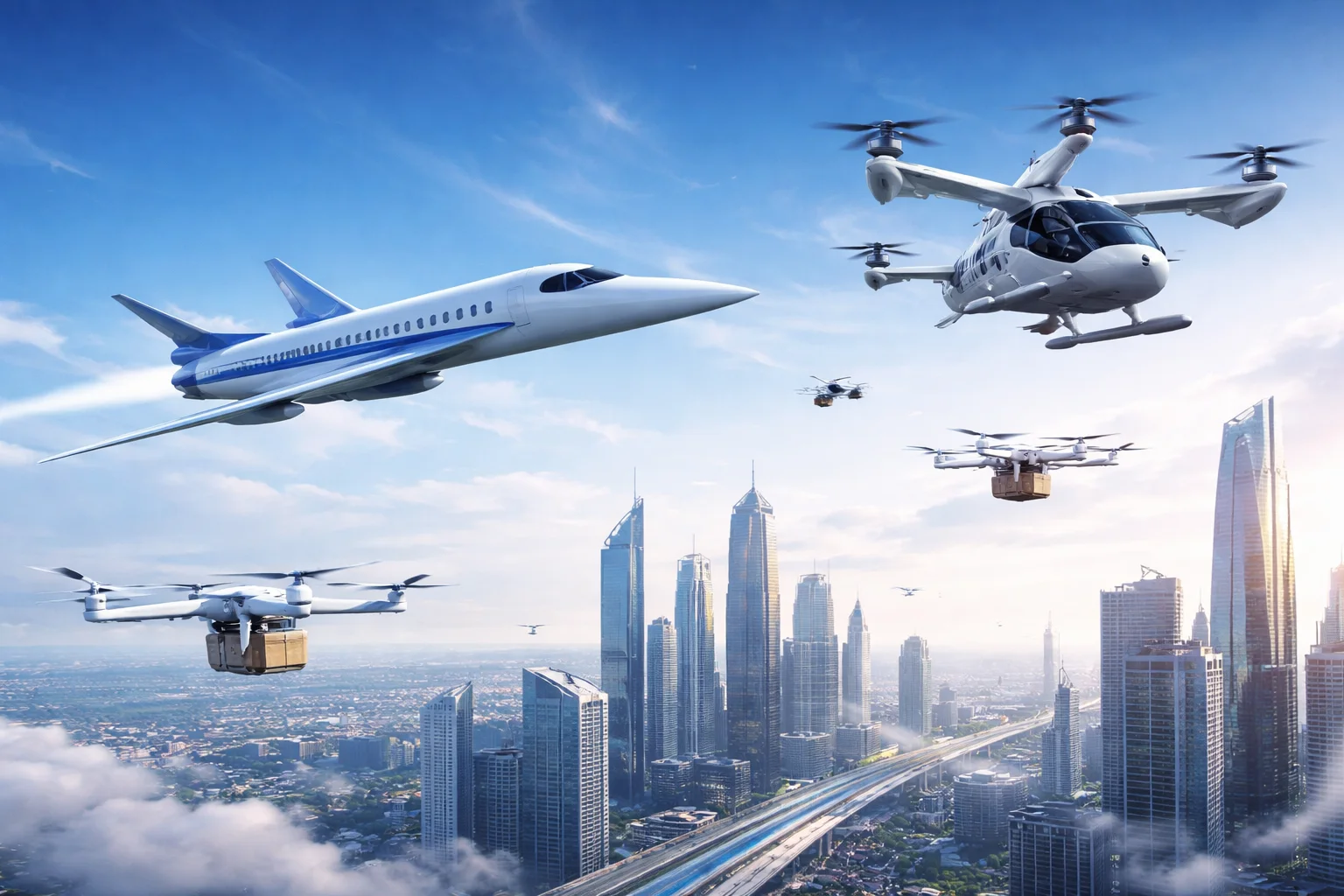
Air travel has always captured human imagination, yet it often feels mysterious to people who rely on it but rarely see how it evolves. Many travelers hear terms like supersonic jets, drones, or urban air mobility and wonder what they actually mean for everyday life. Are these ideas experimental curiosities, or are they part of a broader transformation in how people and goods move through the air?
This article clears that confusion. It explains how modern air travel is changing at a structural level, why these changes matter, and how different forms of aviation are gradually fitting into a shared airspace. Instead of focusing on headlines or timelines, it explores the systems, principles, and patterns shaping the future of air travel.
How air travel is evolving beyond traditional airplanes
For decades, commercial aviation followed a familiar model: large aircraft, fixed routes, centralized airports, and tightly scheduled operations. That model still works well for many journeys, but it is no longer the only approach.
As aviation continues to evolve, new aircraft types and operating concepts are emerging to address gaps that traditional systems were never designed to fill.
Why conventional aviation reached natural limits
Traditional air travel is optimized for long distances and high passenger volumes. It depends on major airports, lengthy ground processes, and significant infrastructure investment. While efficient at scale, this structure struggles with:
- Short-distance travel where ground transport is slow or congested
- On-demand delivery needs that require flexibility rather than fixed schedules
- Urban regions where airport expansion is limited by space and noise concerns
These constraints do not signal failure. Instead, they reveal where complementary aviation solutions can add value.
The shift toward diversified airspace use
Modern aviation increasingly treats airspace as a shared resource rather than a corridor reserved for large jets. This shift allows multiple layers of activity, each designed for specific purposes:
- High-altitude travel for long-distance passenger flights
- Medium-altitude operations for cargo and regional transport
- Low-altitude corridors for drones and urban air vehicles
Managing this diversity safely requires new coordination methods, digital systems, and regulatory frameworks, all built around reliability rather than speed alone.
What supersonic jets represent in modern aviation
Supersonic travel refers to aircraft capable of flying faster than the speed of sound. While this idea has existed for decades, its role in future air travel is often misunderstood.
How supersonic flight works
When an aircraft exceeds the speed of sound, it generates shock waves rather than smooth airflow. These shock waves create what is commonly known as a sonic boom. Designing aircraft to manage this effect requires careful shaping, advanced materials, and precise flight planning.
Supersonic jets typically operate at high altitudes where air resistance is lower, improving efficiency at extreme speeds. However, speed alone does not define their value.
Where supersonic travel makes practical sense
Supersonic jets are best suited for routes where time savings are meaningful and consistent. This often includes:
- Long-distance international travel
- Specialized passenger segments prioritizing speed
- Missions where reduced travel time supports operational efficiency
They are not intended to replace conventional aircraft on all routes. Instead, they complement existing systems by serving specific needs where speed justifies complexity.
Common misconceptions about supersonic aviation
A frequent assumption is that supersonic jets are inherently unsafe or environmentally unsustainable. In reality, safety depends on engineering standards and operational discipline, not speed itself. Similarly, efficiency depends on how aircraft are used, not just how fast they fly.
The role of supersonic travel lies in balance: carefully chosen routes, controlled operating environments, and integration with broader aviation networks.
How drones are reshaping cargo and logistics
Drones are often associated with hobbyists or surveillance, but their most transformative impact lies in logistics and infrastructure support.
What makes drones fundamentally different from aircraft
Drones operate without onboard pilots, allowing them to be smaller, lighter, and more flexible. This design enables:
- Precise, low-altitude navigation
- Rapid deployment without large runways
- Automated operations guided by software systems
These characteristics open possibilities that traditional aircraft cannot efficiently address.
Practical roles drones already fulfill
In modern air travel ecosystems, drones are used for tasks that prioritize speed, precision, or access rather than passenger comfort. Examples include:
- Delivering small, time-sensitive packages
- Inspecting infrastructure such as bridges or power lines
- Supporting emergency response in hard-to-reach areas
These use cases are not experimental concepts; they align with long-standing logistical needs that ground transport struggles to meet.
How drones fit into shared airspace safely
The key challenge with drones is coordination. Safe integration relies on systems that monitor position, altitude, and flight paths in real time. Rather than replacing human oversight, drones add a new layer of automation guided by established aviation principles.
Over time, standardized traffic management systems allow drones to coexist with other aircraft without disrupting established operations.
What urban air mobility really means for cities
Urban air mobility focuses on short-distance flights within and around cities, often using vertical takeoff and landing aircraft. While the idea sounds futuristic, its foundations are practical.
Why cities are central to aviation’s next phase
Urban areas concentrate people, commerce, and infrastructure. Ground congestion, limited space, and growing demand for rapid movement create conditions where air-based solutions become attractive.
Urban air mobility aims to:
- Reduce reliance on long ground commutes
- Connect city centers with surrounding regions
- Offer flexible alternatives during peak congestion
It does not replace public transport but complements it in specific scenarios.
How urban air vehicles differ from helicopters
Although they may appear similar, urban air vehicles are designed around different principles:
- Quieter propulsion systems
- Shorter, more frequent routes
- Greater automation to simplify operations
These design choices reflect a shift toward accessibility and scalability rather than exclusivity.
Infrastructure beyond traditional airports
Urban air mobility depends on compact infrastructure, often referred to as vertiports. These facilities prioritize efficient boarding, rapid turnaround, and integration with existing transport networks.
By distributing takeoff and landing points across urban regions, cities can avoid the bottlenecks associated with centralized airports.
How these technologies work together in a unified system
Supersonic jets, drones, and urban air vehicles are not competing ideas. They address different layers of mobility and function best when integrated.
Layered airspace as a model
Future air travel relies on structured airspace layers, each optimized for specific types of movement:
- High altitudes for long-distance, high-speed travel
- Mid-level airspace for regional and cargo operations
- Low-altitude corridors for urban and local mobility
This layered approach mirrors how road systems separate highways, arterial roads, and local streets.
The role of automation and data
Across all forms of modern aviation, digital systems play a central role. Automation supports navigation, traffic management, and safety monitoring. Data sharing ensures that each aircraft understands its environment without relying solely on human reaction time.
Importantly, these systems are designed for resilience, allowing safe operation even when conditions change unexpectedly.
See also How Satellites Support Flight Tracking and Air Traffic Management
Challenges that shape long-term adoption
Every advancement in air travel must overcome structural challenges before it becomes routine.
Safety as a continuous process
Aviation safety is built on redundancy, testing, and standardization. New technologies are evaluated not by novelty but by their ability to meet or exceed existing safety benchmarks.
This process is gradual by design, ensuring trust is earned rather than assumed.
Noise, energy, and community impact
Public acceptance depends on how aviation affects daily life. Noise levels, energy use, and visual impact all influence where and how new aircraft operate.
Solutions focus on minimizing disruption while maximizing utility.
Regulation as an enabler, not an obstacle
Regulatory frameworks often appear restrictive, but they provide the structure that allows aviation systems to scale responsibly. Clear rules enable consistent operations, predictable safety outcomes, and international cooperation.
Frequently asked questions
Will future air travel replace traditional airplanes?
No. Traditional airplanes remain essential for long-distance and high-capacity travel. New aviation technologies complement existing systems by addressing different travel needs rather than replacing them.
Are drones and urban air vehicles safe around people?
Safety depends on design, regulation, and operation. When integrated properly, these systems follow strict safety standards similar to other forms of aviation, with additional safeguards for operating near populated areas.
Does faster air travel always mean higher environmental impact?
Not necessarily. Environmental impact depends on efficiency, routing, and energy sources. Speed alone does not determine sustainability; system design and usage patterns matter more.
Conclusion
The future of air travel is not defined by a single breakthrough but by a gradual expansion of how airspace is used. Supersonic jets offer speed where it truly matters, drones enhance logistics and accessibility, and urban air mobility addresses challenges unique to modern cities.
Together, these developments reflect a broader shift toward flexibility, integration, and thoughtful system design. By focusing on fundamentals rather than headlines, it becomes clear that air travel is evolving in ways that prioritize safety, efficiency, and real-world needs. This layered, adaptive approach ensures that aviation remains a reliable part of global mobility for the long term.

Related Posts