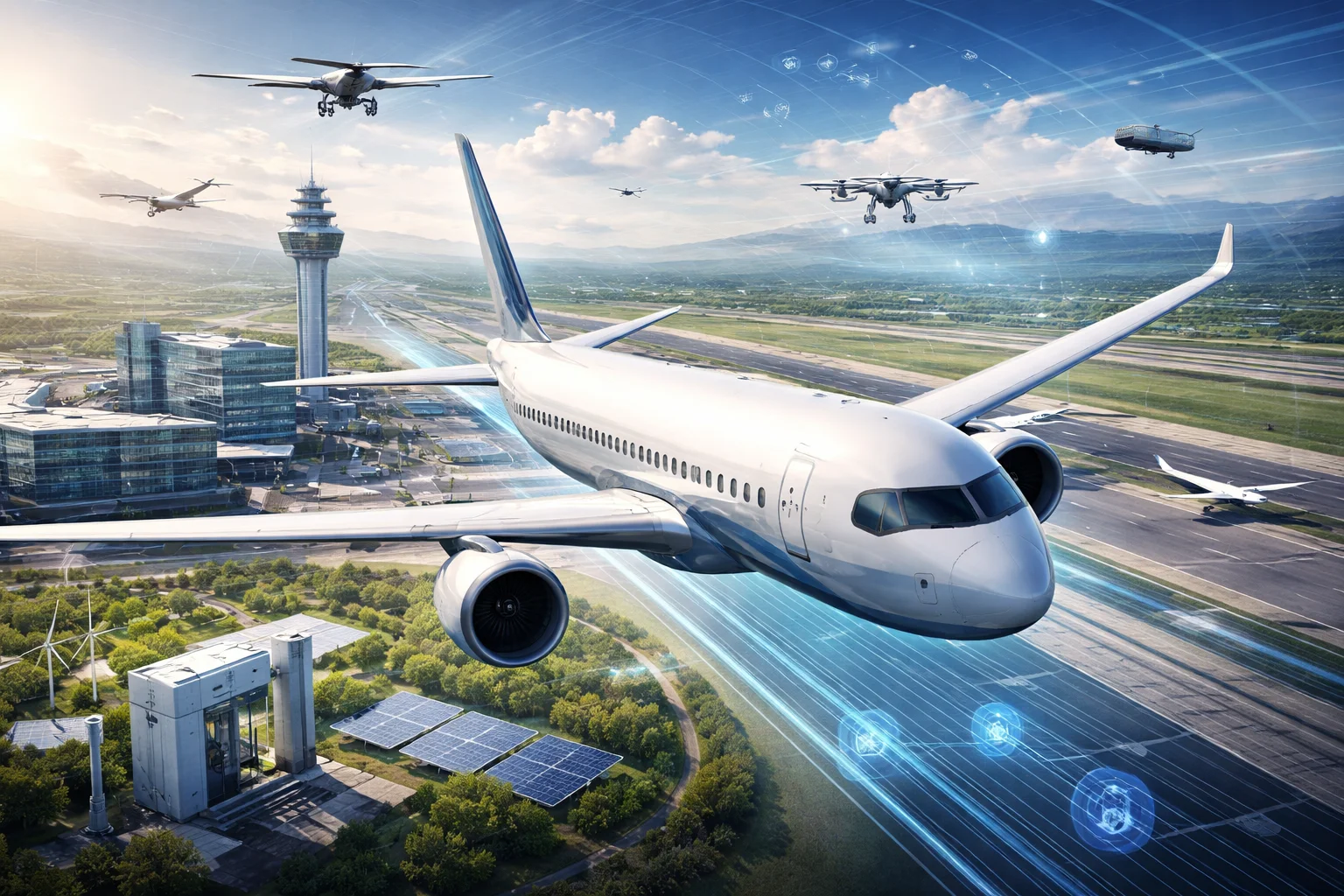
Introduction: Why aviation feels more complex than ever
Many people sense that aviation is changing fast, but struggle to explain how or why. Aircraft still take off and land much as they always have, yet behind the scenes, the systems guiding pilots, airlines, airports, and passengers are evolving in quieter, deeper ways.
This guide is designed to clear that confusion. It explains the long-term aviation technology trends shaping how flying works, why these changes matter, and how they affect safety, efficiency, and the overall experience—without relying on short-lived news or time-sensitive claims.
Rather than focusing on announcements or hype, this article explores the core systems, patterns, and technologies that continue to redefine modern aviation.
How digital systems are reshaping aircraft operations
At the heart of aviation’s transformation is the steady shift from mechanical processes to integrated digital systems.
From isolated instruments to connected flight systems
Traditional aircraft relied on separate instruments for navigation, engine performance, and flight control. Modern aircraft increasingly bring these elements together into unified digital environments. Pilots interact with clearer displays, automated cross-checks, and system alerts that reduce cognitive load rather than add to it.
This integration improves consistency. When systems share data, errors are easier to detect and respond to before they become serious.
Smarter automation without removing human control
Automation in aviation is often misunderstood. The goal is not to replace pilots, but to support them. Advanced flight management systems handle routine tasks such as speed optimization, fuel management, and route adjustments, allowing crews to focus on decision-making and situational awareness.
The most effective automation is designed to be predictable, explainable, and reversible—so humans remain in command even as systems grow more capable.
Why sustainability is becoming a core design principle
Environmental responsibility is no longer an optional add-on in aviation. It influences aircraft design, operational planning, and long-term infrastructure decisions.
Efficiency before reinvention
Many sustainability gains come from improving what already exists. Lighter materials, refined aerodynamics, and optimized flight paths reduce fuel consumption without changing how passengers experience a flight.
Incremental efficiency improvements often deliver more reliable results than radical redesigns, especially in a safety-critical industry.
Cleaner energy as a system challenge
Alternative energy sources are often discussed as individual solutions, but aviation treats them as part of a broader system. Fuel compatibility, storage, supply chains, and certification standards must align before any new energy approach can scale safely.
As a result, progress tends to be steady and methodical rather than sudden or disruptive.
How data is changing decision-making across aviation
Aviation has always been data-driven, but the volume and usefulness of data have grown significantly.
Predictive maintenance replacing reactive repairs
Instead of waiting for parts to fail or relying solely on fixed schedules, airlines increasingly use sensor data to anticipate wear and performance changes. This allows maintenance teams to intervene earlier, improving reliability while reducing unexpected delays.
Predictive approaches work best when paired with human expertise, turning raw data into practical action.
Operational intelligence beyond the cockpit
Airports, air traffic services, and airlines now coordinate through shared data environments. This helps manage congestion, weather disruptions, and resource allocation more smoothly.
When systems communicate clearly, small adjustments can prevent larger operational issues from developing.
What connectivity means for passengers and crews
Connectivity is often associated with in-flight internet, but its impact goes far beyond passenger convenience.
Real-time aircraft awareness
Connected aircraft can share performance data with ground teams during flight. This allows crews on the ground to prepare maintenance plans, gate assignments, or operational adjustments before the aircraft even lands.
The result is smoother turnarounds and fewer last-minute surprises.
Passenger experience as a system outcome
Entertainment, communication, and service personalization are not isolated features. They depend on aircraft power management, network reliability, and data security. When these systems are designed together, the passenger experience feels seamless rather than fragmented.
How safety evolves through layered technology
Aviation safety does not rely on single breakthroughs. It improves through overlapping layers of technology, training, and procedures.
Redundancy as a design philosophy
Critical systems are built with multiple backups that operate independently. If one component fails, others maintain safe operation. This principle applies to navigation, communication, power, and control systems.
Redundancy is not a sign of inefficiency—it is a deliberate safety strategy.
Training that evolves with technology
As systems change, so does pilot and crew training. Modern training focuses on understanding system behavior, recognizing edge cases, and managing automation effectively. The goal is not memorization, but adaptability.
Well-designed training ensures technology enhances safety rather than complicating it.
How airspace management is adapting to complexity
The skies are becoming more diverse, with different types of aircraft sharing airspace.
Coordinating varied aircraft types
Commercial jets, cargo aircraft, private planes, and emerging aerial vehicles all have different performance profiles. Airspace systems increasingly rely on digital coordination to manage these differences safely.
Clear rules, shared data, and standardized communication remain essential foundations.
Balancing capacity with predictability
More traffic does not automatically mean less safety. When managed well, increased capacity can coexist with predictable operations. The challenge lies in aligning technology, procedures, and human decision-making.
Common misconceptions about aviation technology
Understanding what aviation technology does not do is just as important as knowing what it does.
“More technology means less safety”
In practice, the opposite is usually true. Most safety improvements come from better information, earlier warnings, and clearer system behavior—not from removing human involvement.
“Innovation happens overnight”
Aviation values reliability over speed. New technologies are tested, refined, and certified over long periods. This careful pace is a strength, not a weakness.
Frequently Asked Questions
How do aviation technology trends affect everyday passengers?
Most changes happen behind the scenes. Passengers benefit through smoother flights, fewer disruptions, improved comfort, and consistent safety standards—even if the aircraft looks familiar.
Is automation making pilots less important?
No. Automation shifts the pilot’s role toward supervision, decision-making, and system management. Human judgment remains central to safe flight operations.
Why does aviation adopt new technology slowly?
Because safety, certification, and reliability matter more than speed. Technologies are introduced only after they prove consistent and predictable under real-world conditions.
Conclusion: Understanding change without chasing headlines
Aviation technology evolves through steady refinement, not sudden reinvention. The most important trends are not flashy announcements, but deeper shifts in how systems connect, how decisions are made, and how safety is reinforced.
By focusing on fundamentals—automation that supports humans, data that improves reliability, and sustainability built into design—modern aviation continues to move forward in ways that remain trustworthy and resilient over time.
Understanding these patterns makes it easier to see not just what is changing in the skies, but why those changes matter.

Related Posts