Flying is one of the safest ways to travel, yet many people still wonder how safety is maintained when thousands of aircraft are in the air at the same time. A common question comes up again and again: How do airlines and aviation authorities prevent small issues from turning into serious incidents?
This article clears up that confusion by explaining how artificial intelligence fits into aviation safety. Instead of hype or headlines, it focuses on the systems, principles, and practices that make AI a dependable safety partner in aviation. By the end, you’ll understand where AI is used, how it supports human decision-making, and why it strengthens safety rather than replacing people.
Understanding the Role of Artificial Intelligence in Aviation Safety
Artificial intelligence in aviation is not a single system or tool. It is a collection of technologies designed to analyze data, recognize patterns, and support safer decisions across the entire flight lifecycle.
What AI Means in an Aviation Context
In aviation, AI refers to systems that can process large volumes of information and learn from operational patterns. These systems help identify risks that may not be obvious through manual monitoring alone.
Unlike simple automation, AI adapts. It refines its models based on real-world inputs such as weather behavior, aircraft performance data, and maintenance records. This adaptability is what makes AI valuable for safety-critical environments.
AI as a Decision-Support System, Not a Replacement
One of the most common misconceptions is that AI “flies the plane.” In reality, AI supports pilots, engineers, and controllers by highlighting insights they can act on.
Human expertise remains central. AI tools are designed to reduce workload, minimize oversight errors, and provide early warnings—not to remove responsibility from trained professionals.
How AI Improves Flight Safety Before Takeoff
Safety starts long before an aircraft leaves the ground. Many risks are best addressed during planning, inspection, and preparation.
Predictive Maintenance and Early Fault Detection
Aircraft generate enormous amounts of sensor data during every flight. AI systems analyze this data to detect subtle performance changes that might indicate future component wear or failure.
Instead of waiting for a part to fail or relying solely on fixed inspection intervals, maintenance teams can address issues proactively. This reduces unexpected technical problems and improves aircraft reliability.
Smarter Flight Planning and Risk Assessment
AI assists in evaluating multiple flight variables at once, including weather patterns, fuel efficiency, air traffic density, and aircraft weight.
By comparing thousands of possible scenarios, AI systems help planners choose routes that reduce exposure to turbulence, congestion, or operational stress—factors that directly affect safety margins.
AI Support During Flight Operations
Once an aircraft is airborne, safety depends on continuous awareness and timely decision-making.
Enhanced Situational Awareness for Pilots
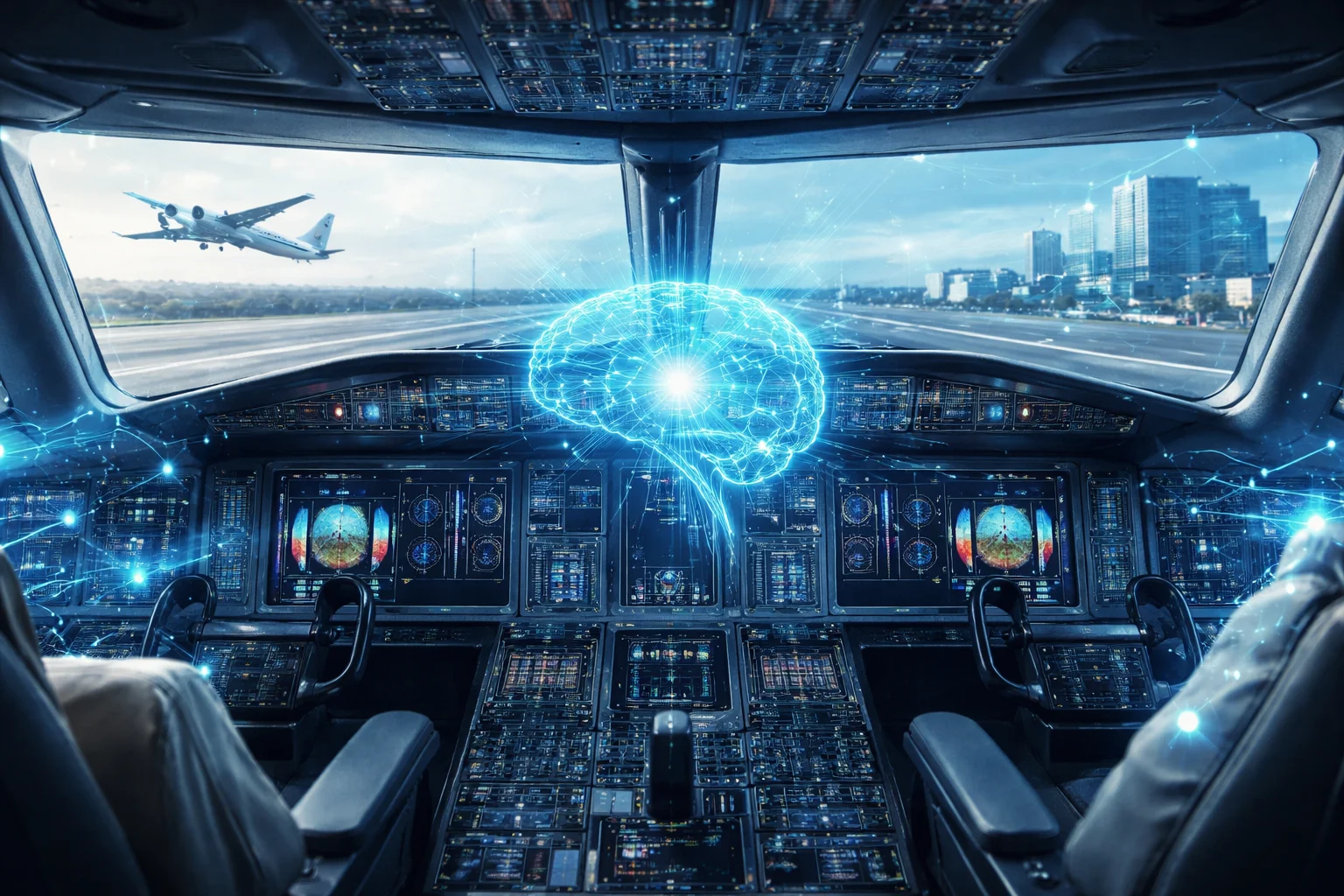
Modern cockpits already integrate vast amounts of information. AI helps organize this data in ways that are easier to interpret under pressure.
For example, AI-driven alerts prioritize the most critical information, reducing the chance that a pilot overlooks an important signal during complex situations.
Weather Pattern Analysis and Hazard Avoidance
Weather remains one of the most unpredictable elements in aviation. AI models analyze atmospheric data to identify developing conditions such as turbulence, wind shear, or storm formation.
Rather than reacting late, flight crews receive earlier and more precise guidance, allowing smoother adjustments that maintain passenger comfort and structural safety.
Improving Air Traffic Management and Collision Prevention
Safety in the air is not only about individual aircraft. It also depends on coordination across the entire airspace.
AI in Air Traffic Flow Management
Air traffic controllers manage dense networks of aircraft with limited room for error. AI systems help predict traffic bottlenecks and recommend spacing adjustments that maintain safe separation.
These systems don’t replace controllers. Instead, they act as advanced assistants, processing complex variables faster than manual methods.
Conflict Detection and Resolution Support
AI models continuously analyze aircraft trajectories to identify potential conflicts well in advance.
By offering multiple resolution options, AI gives controllers the information needed to choose the safest and most efficient solution while maintaining full human oversight.
Training, Simulation, and Human Performance Enhancement
Safety also depends on how well people are trained to respond to both routine and unexpected situations.
Smarter Pilot Training Through Adaptive Simulations
AI-powered simulators adjust scenarios based on trainee performance. If a pilot struggles with a specific situation, the system can introduce variations that reinforce learning without unnecessary repetition.
This targeted approach strengthens decision-making skills and improves preparedness for rare but critical events.
Monitoring Fatigue and Human Limitations
Human performance varies due to fatigue, workload, and stress. AI tools analyze patterns such as reaction times and operational inputs to identify signs of overload.
When used responsibly, these insights help organizations adjust schedules, procedures, or support systems to maintain safe performance levels.
Addressing Safety Concerns and Common Misconceptions
As with any advanced technology, AI raises important questions about trust and accountability.
Transparency and Explainability in Safety Systems
In aviation, safety systems must be understandable, not mysterious. AI models used in safety-critical roles are designed with explainability in mind.
This allows engineers and regulators to understand why a system produced a particular recommendation, reinforcing trust and accountability.
Regulation, Standards, and Human Oversight
Aviation operates under strict international standards. AI systems are evaluated, tested, and integrated within these frameworks rather than operating independently.
Human oversight is not optional—it is a foundational requirement. AI enhances compliance by improving consistency and early risk detection.
Impact of AI on Aviation Safety Culture
Beyond individual tools, AI influences how safety is approached as a whole.
From Reactive to Preventive Safety Models
Traditional safety systems often focused on responding after incidents occurred. AI enables a shift toward prevention by identifying weak signals before they escalate.
This proactive mindset aligns with aviation’s long-standing commitment to continuous improvement.
Strengthening Trust Through Consistency
When safety systems behave predictably and reliably, trust grows. AI contributes by applying consistent logic across massive datasets, reducing variability caused by human fatigue or information overload.
Frequently Asked Questions About AI in Aviation Safety
Does AI make flying safer than traditional systems alone?
AI improves safety by enhancing existing systems, not replacing them. It supports earlier detection of risks and better-informed decisions while keeping humans in control.
Can AI systems fail, and how is that risk managed?
All systems can fail, which is why aviation relies on redundancy and layered safety approaches. AI tools are designed to complement, not become single points of failure.
Will pilots and controllers always remain involved?
Yes. Human judgment, responsibility, and oversight remain essential. AI is built to support professionals, not remove them from the safety loop.
Conclusion: A Quiet but Powerful Safety Partner
Artificial intelligence has become an integral part of how aviation manages safety, often working quietly in the background. By analyzing data, recognizing patterns, and supporting human decisions, AI strengthens safety across planning, operations, and training.
The most important takeaway is this: AI does not replace human expertise—it reinforces it. When designed, regulated, and used responsibly, artificial intelligence helps aviation maintain the high safety standards people rely on every time they fly.

Related Posts