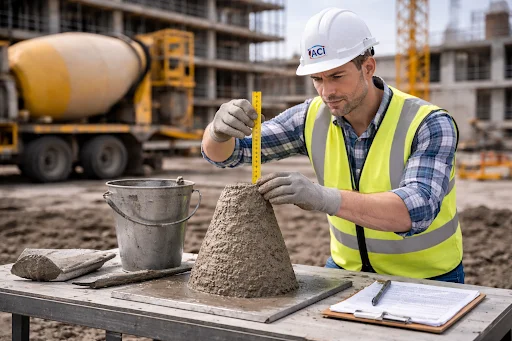
Every time a new skyscraper breaks ground in a smart city corridor, billions of dollars and thousands of lives quietly depend on someone in a hard hat filling a cone with concrete. In 2026, that moment has not changed — even if almost everything around it has. Sensors talk to satellites, algorithms predict curing rates, and some mixes can literally close their own cracks. But the person holding the tamping rod still needs a credential that proves they know what good concrete looks like, feels like, and tests like.
Urban development has arrived at a fascinating crossroads. The materials are smarter. The tools are faster. The buildings are taller and the deadlines shorter. But the human standard for quality control — embedded in law and enforced on every major public project — has only grown stricter. Understanding how these two forces interact tells you a lot about where infrastructure careers are headed.
Smart Concrete Is Changing What Gets Built — Not Who Signs Off
Self-healing concrete is no longer a laboratory curiosity. In 2026, municipalities across North America and Europe are specifying mixes embedded with bacteria or mineral capsules that activate when micro-fractures appear, effectively patching damage before an inspector ever spots it. Meanwhile, distributed sensor networks — threaded into bridge decks and tunnel linings — continuously stream compressive-strength data to city operations centers.
The practical upside is enormous. Engineers can catch structural drift in real time, reroute traffic before a deck deteriorates, and extend the maintenance cycle of critical infrastructure. For city planners trying to build resilient grids in the face of climate stress, smart concrete is less a luxury than a necessity.
What it does not replace, however, is the certified technician on the pour floor. Sensors provide trend data. They do not issue certificates of compliance. They cannot be cross-examined in court. And they were not there when the batch came off the truck. Every load of ready-mix concrete that goes into a regulated structure still needs a physical test — slump, air content, temperature, unit weight, and cylinders for compressive strength — performed by a qualified human being following ASTM protocols.
The Legal Weight of ACI Grade 1 Certification
The American Concrete Institute’s Field Testing Technician Grade 1 certification is the industry standard that most state DOTs, transit authorities, and municipal building departments require by name. It covers the same five core ASTM tests that technicians have performed for decades — but the bar for passing has never been more demanding, partly because the buildings are bigger and partly because regulators have learned expensive lessons from failures that trace back to improper sampling.
While 2026 has introduced self-healing concrete and embedded sensors into our urban landscapes, the human element of quality control remains irreplaceable. The ACI Field Testing Technician remains the final authority on whether a batch of concrete meets the structural requirements of a high-rise. Because the margin for error in urban construction is zero, the certification process is designed to be punishing. To sharpen their accuracy, many aspiring inspectors incorporate a realistic ACI practice test into their study routine, allowing them to simulate the pressure of the performance exam and master the latest ASTM testing protocols.
The performance exam itself — conducted at regional certification events — places candidates under real time pressure with real tools and real materials. There is no multiple-choice shortcut for demonstrating that you can perform a proper slump test. You either know the procedure or you fail in front of an evaluator.
Why Urban Projects Cannot Afford Unverified Data
A single improperly sampled cylinder can delay a high-rise pour by days — and a rejection at the lab means a costly investigation. When cities are racing to meet housing targets and infrastructure deadlines, that kind of setback has ripple effects on budgets, timelines, and public confidence. The case for investing in certified inspectors is, ultimately, economic, not just regulatory.
Smart sensors extend the life of structures and improve operational awareness. ACI-certified technicians ensure those structures are built correctly in the first place. The two roles are complementary, not competitive. A building’s sensor network is only as reliable as the concrete it is embedded in — and that concrete’s quality was verified by a person, on a specific day, under specific conditions, using a documented and legally defensible method.
A Career Path Built to Last
For anyone considering a move into construction quality control, 2026 is an unusually good time to start. Infrastructure investment across the United States is running at historic levels, driven by federal programs targeting bridges, transit systems, and climate-resilient housing. Every one of those projects requires concrete testing technicians at every pour.
Candidates preparing for the written portion of the exam should review the official program requirements published by the ACI Certification Programs, which outline the specific ASTM standards covered, renewal requirements, and regional testing schedules.
The job is physically demanding and technically precise. It also carries genuine authority: the inspector’s signature on a test report is, in a legal sense, the city’s guarantee that the building is safe. Smart cities are only as smart as the people who build them — and in concrete construction, that guarantee still starts with a human being, a set of tools, and an earned credential.

Related Posts